Dearborn Public Schools is asking voters to consider a transformational bond for the district on Nov. 3, 2026.
This is a critical time for the district because we can raise $1.5 billion without changing the total tax rate for Dearborn homeowners. This money will be used to build new schools, improve safety across the district, add hands-on STEAM learning spaces, renovate at every school, and eventually ensure that every school is air-conditioned. Every student would see improvements within three years.
Learn more about the bond at one of our upcoming community meetings. Find the full list on the district’s calendar page.
Twenty years of transformational change
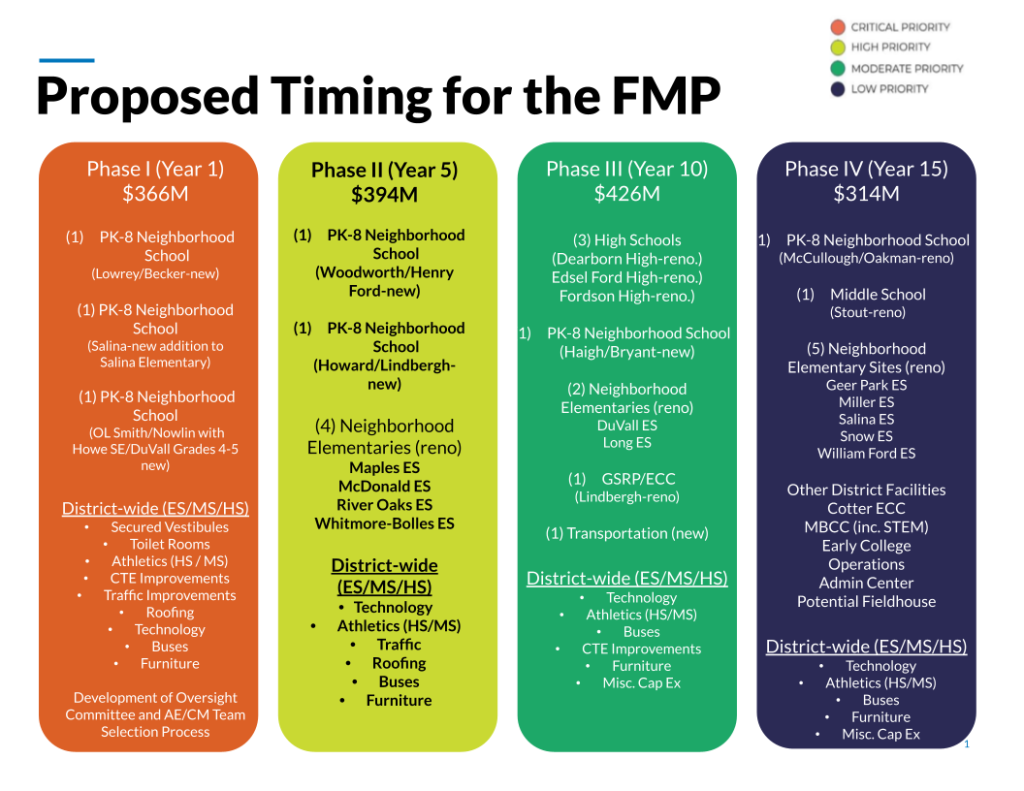
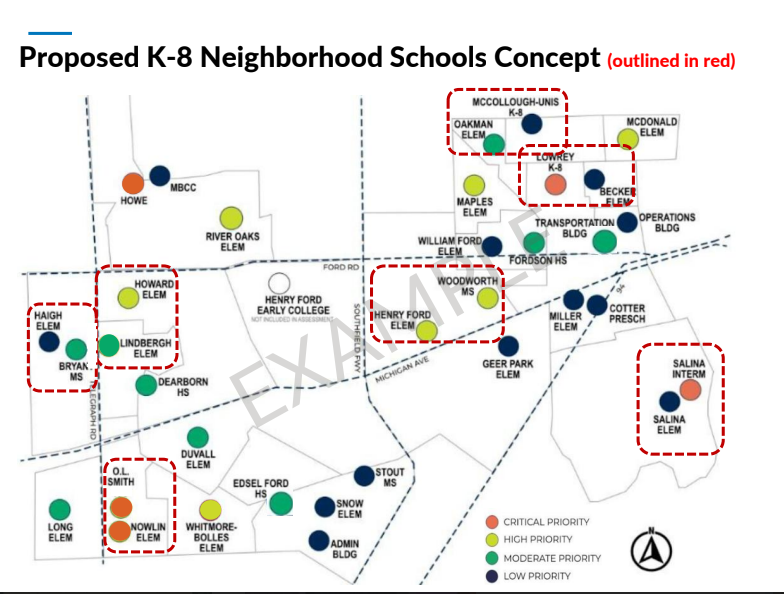
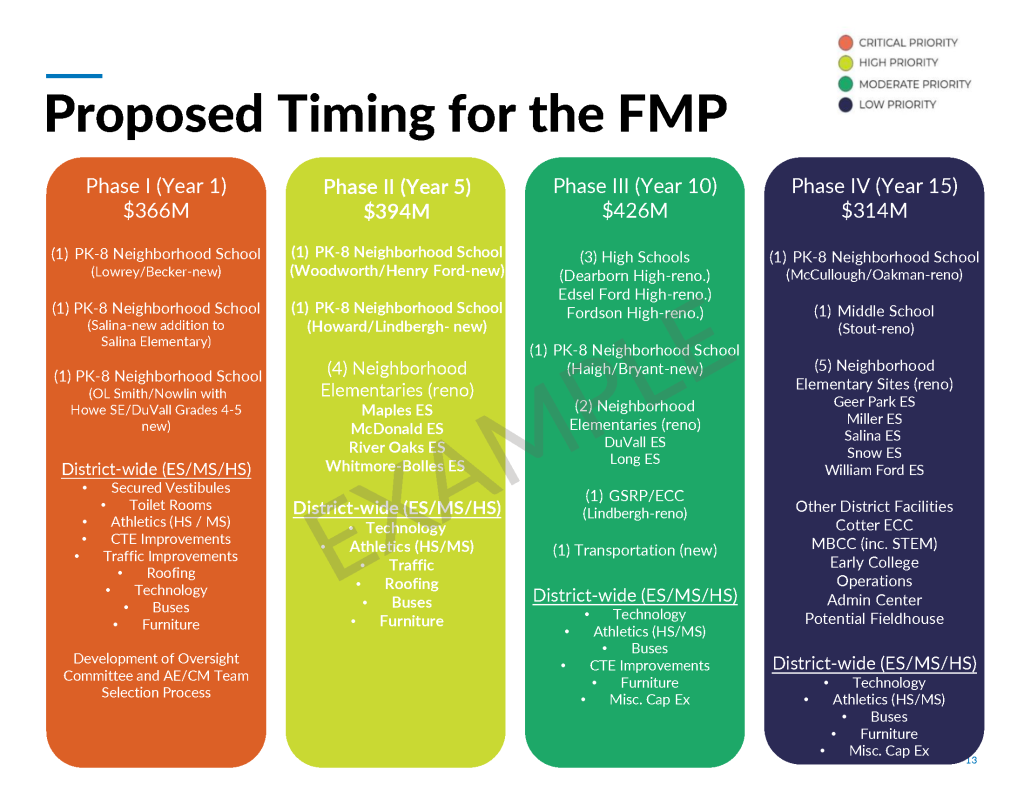
Bond work would be issued in four phases over the twenty years. Plans call for building six new preschool through eighth grade buildings (preK-8) and major renovations for all of the remaining elementary and middle schools. Fordson, Dearborn and Edsel Ford high schools would keep their current buildings and see extensive renovations. Every wave of work would help any building that hasn’t already been rebuilt or fully renovated. Phase 1 would include adding secure vestibules at 24 schools, improving restrooms, expanding career and technical educations, refurbishing athletic facilities, updating technology, fixing roofs, and replacing buses. In the first two phases of the bond, the district plans to refurbish every group restroom in every school that is not being replaced. The bond also would fund urgent repairs for boilers, roofs, HVAC and more at schools across the district.
For more details, see:
Facilities Master Plan report to the board from June 22, 2026
Salina updated Oct. 12, 2026
Quinn Evans Assessment Report to review detailed facility findings by school
No mill increase for Dearborn homeowners
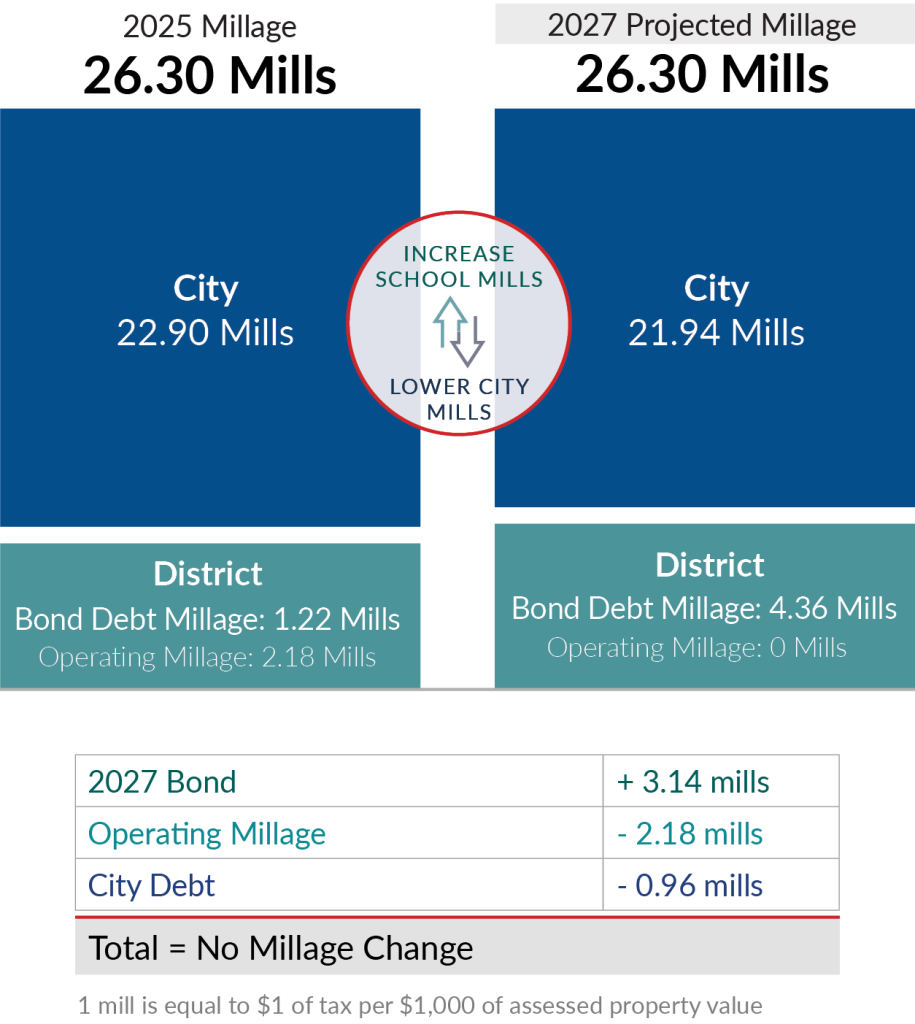
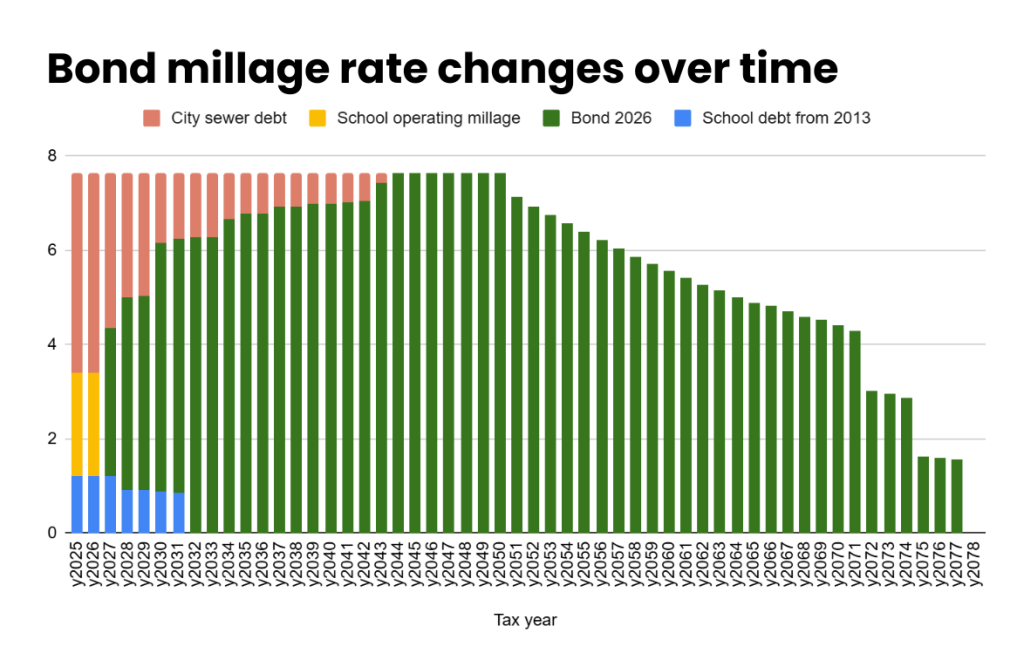
The bond question will ask voters to consider a 3.14 mill increase on their tax bills. For City of Dearborn homeowners, that entire increase will be offset by reductions in other taxes collected by Dearborn Public Schools and the City of Dearborn. If the bond is approved, the tax rate for Dearborn homeowners will stay at 26.30 mills total for the city and school district.
Dearborn Heights homeowners would see school millage increase 0.96 mill with the bond. (Technically, their millage would fall from the corrected 2026 rate. See the FAQs for more details) For homeowners, the total school millage would still be less than they paid in 2024 and less than half what they paid in 2021.
Why preK-8 schools?
Combining existing buildings into new schools will allow the district to reduce its total footprint to less than 2 million square feet. Instead of maintaining two buildings only blocks apart, the district would have one new, modern facility for students. Elementary and middle school students would be separated for classes, meals, recess, lineup, and dismissal, but all students could use special spaces like STEM labs, music rooms, and gymnasium-auditoriums. Students and families would benefit from staying in the same neighborhood school for up to 10 years – from free GSRP preschool through eighth grade.
Community input at every stage
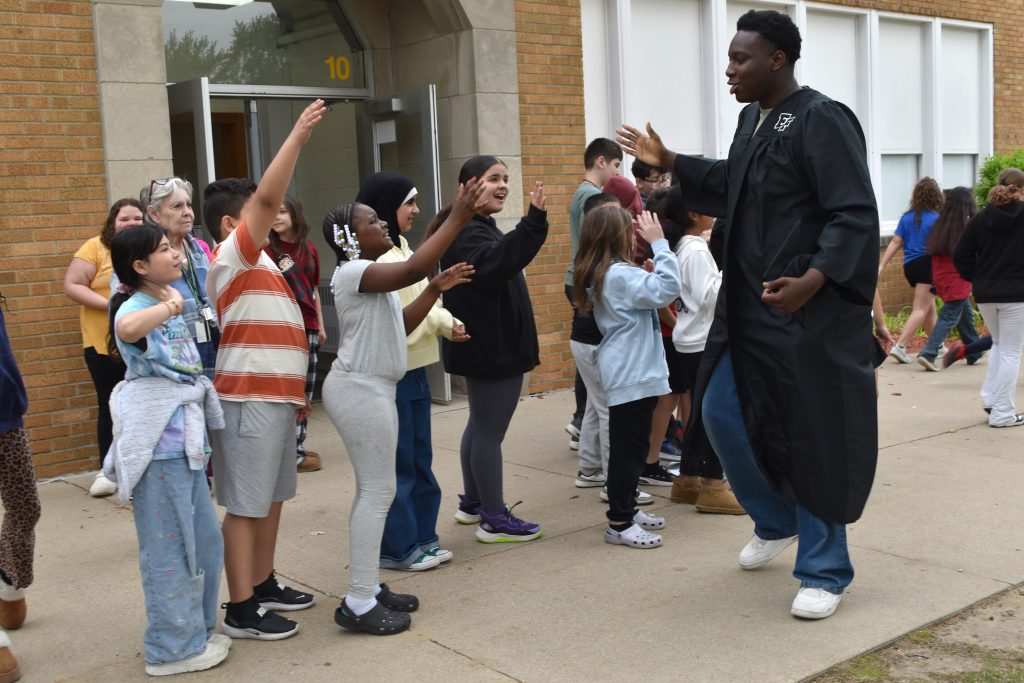
At each phase of the bond, the district would gather community input on the plans for the next stage. Plans can and will evolve to adapt to any changes in community or education needs over the 20 years. The district will also provide regular public updates on how bond money is being spent and the plans and status of different projects.
How have the district’s tax rates changed over the years?
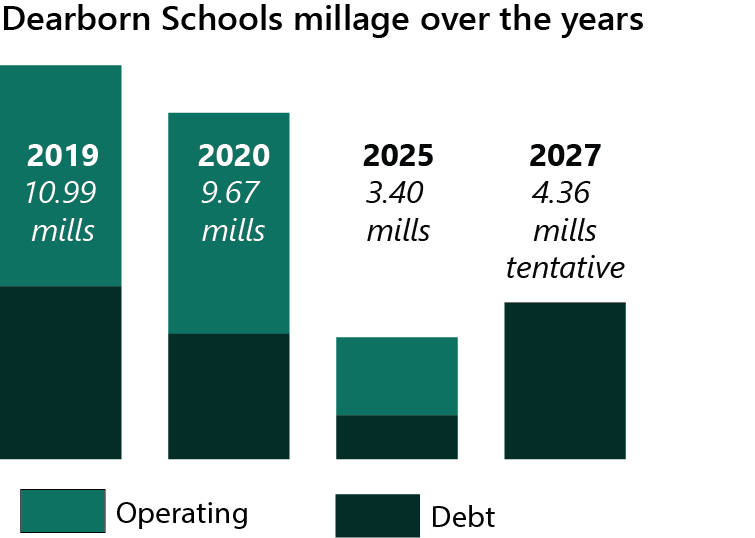
When the district last asked voters for a bond in 2019, the district’s total tax rate was 10.99 mills, including 6.17 for the operating millage, then called the hold harmless.
Since then the district has paid off one bond and the state slashed how much funding the district is allowed to collect in its operating millage on homeowners.
For 2025, the district’s total millage was 3.40 mills for both operating and debt millage. That is one-third of the millage rate the last time the district asked for a bond.
Other resources
Check back here for more resources as they become available
Facilities Planning page – This site contains lots of historical data about facilities work and planning in the district.
Bond presentation for community meetings
Otros recursos
Actualización del Plan Maestro de Instalaciones
Frequently Asked Questions
Unfortunately, that’s even more complicated than usual.
In the simplest terms, homeowners in Dearborn Heights would see their district property taxes with the bond climb by 0.96 mills. For homeowners in the City of Dearborn, that part of the bond is being offset by the end of the city’s millage for the combined sewer overflow project, which is why those residents have a no-millage increase with the bond.
However, in actual bills, Dearborn Heights homeowners would see their school millage under the new bond fall by almost a mill from this year to next year (the 2026-27 billing cycle to the 2027-28 cycle).
Due to an error at the Dearborn Heights City Clerk’s office, homeowners were not assessed the district’s 2.18 operating millage on the summer 2025 and winter 2026 tax bills. As a result, those homeowners in the 2026-27 tax cycle will see two years of operating millage for a total of more than 4 mills plus the district’s existing debt millage. Combined, those millages are about a mill higher than the total district tax rate Dearborn Heights homeowners would pay if the bond is passed.
The total tax rate for Dearborn Homeowners would NOT change under the bond.
If the bond passes, the tax rate for the bond would gradually change over the decades, increasing only as other taxes decline. Those other dwindling taxes include the City of Dearborn’s debt for its combined sewer overflow project and debt from the district’s last bond. The district would also waive its flat 2.18 operating millage on homeowners.
Several safeguards will be in place to ensure the bond funds are properly handled and spent.
Bonds will be issued in eight series to fund four phases of work. Before each phase, the district will take community input to help with planning the next stages of work. If the Board of Education has concerns, trustees can always decide not to issue the next round of bonds.
Throughout the process, the district will have an oversight committee, including community members, to watch over bond projects and spending. The district will also create a website tracking bond projects and spending for public review. Also, under state law any money received and spent through the bond must pass state audits.
See the accountability graphic.
In November 2019, voters narrowly rejected a $240 million bond proposal by just 242 votes. The proposal was designed to fund infrastructure improvements and safety upgrades across the district. Following the election, community feedback emphasized the importance of developing a long-term facilities plan, reducing district millage rates, and incorporating new, transformational projects that would better position the district for the future.
In response, Dearborn Public Schools spent the following years conducting extensive facilities studies, educational planning efforts, and community engagement initiatives to align its infrastructure plans with evolving instructional practices and community priorities. This work included partnerships with Cropper GIS on a demographic study (2022), Fielding International on instructional trends and future-ready learning environments (2023), Quinn Evans on districtwide building assessments and project prioritization (2025), and Byrum & Fisk on stakeholder input, including a community survey (2025).
Together, these efforts helped identify a strategic path forward focused on addressing critical facility needs, undertaking major renovations, and new construction projects, and enhancing learning environments for all students within a realistic funding framework. The findings and recommendations from these studies were presented publicly throughout the planning process by district administrators and the firms above.
Learn more on the district’s Facilities Planning Resources page.
By state law, non-homestead property is always taxed at 18 mills for the district operating millage. This includes businesses, rentals, second homes, and any other property besides a person’s primary home. So these properties would not benefit from the district waiving the 2.18 mills on homeowners.
For non-homestead properties in Dearborn, their total city and school tax rate would go up by 2.18 mills. They will still see the end of the city’s CSO millage, offsetting part of the increase from the bond.
Non-homestead properties in Dearborn Heights would see the full 3.14 mills increase.
The district’s total debt millage if the bond is approved would be about 4.36 mills including the new millage and the remaining debt millage from the 2013 bond. For comparison, the debt millage rate was 4.82 mills in 2019 when the district last asked for a bond.
City of Dearborn homeowners would save 0.96 mills a year without the bond because the City of Dearborn sewer millage would fall off the tax bill. This figures to about $96 for a home worth about $200,000.
Dearborn Heights homeowners would not see any change to their district tax bill if the bond fails.
While the bond would add 3.14 mills to homeowners’ tax bills, Dearborn Public Schools will offset most of that amount by not collecting its 2.18 mill operating millage if the bond passes. If the bond does not pass, the district will continue to collect the 2.18 operating millage from homeowners.
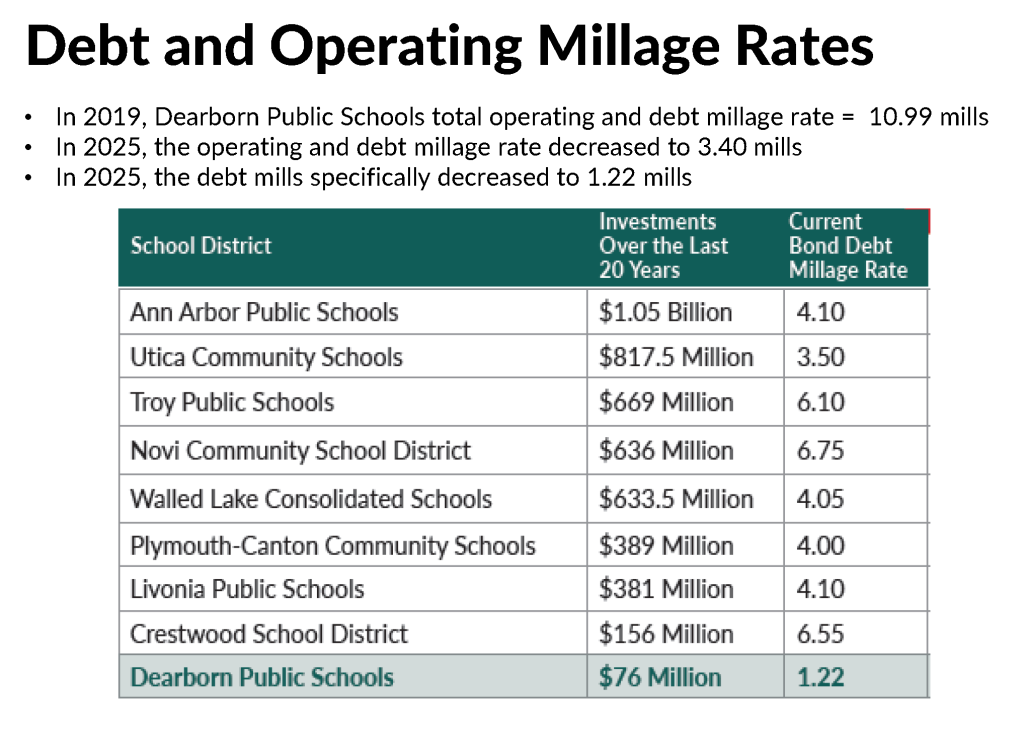
The district collected 1.22 mills for debt in the 2025-26 tax year. That is far below most districts in the area. Districts such as Troy, Novi, and Crestwood collect more than 6 mills for school debt.
Dearborn Schools is also well behind many other districts in how much it has bonded for school infrastructure. In the last 20 years, Dearborn Schools has bonded only $76 million for school infrastructure. Many smaller districts have bonded more than four times that amount including Livonia, Plymouth-Canton, Walled Lake, Novi, Troy, and Ann Arbor.
Bond work would be completed over about 20 years and the bond repaid in about 30 years. Projects would be implemented in four phases. This approach allows for ongoing community input and engagement throughout the bond program, ensuring that residents continue to play an important role in shaping district priorities and project decisions. A phased approach will also allow plans to evolve to changing educational and community needs.
Without bond approval, critical improvements would be delayed, and the district could not implement larger educational changes needed in our schools. Maintenance and repairs would need to be paid for with general fund dollars that could otherwise support classroom learning.
Research indicates that communities with modern, well-maintained school facilities tend to experience stronger property values and long-term economic stability.
Voters can see if they are register and request absentee ballots online through the Michigan Secretary of State’s office. Visit your local city clerk to register.
As planning for the district’s long-term facilities program continued in 2025, Dearborn Public Schools also considered the level of coordination and oversight that would be needed to successfully manage a large, complex, and multi-phased capital improvement program. Recognizing that the district’s primary role is to educate students and operate its schools, district leaders explored the idea of engaging an owner’s representative to provide dedicated program management and oversight.
During a public Board of Education meeting in February 2026, the district’s chief financial officer provided additional information regarding the role of an owner’s representative and the value such a partner could bring to a large capital program. An owner’s representative serves on behalf of the district to coordinate architects, engineers, and construction managers; assist with contract negotiations; oversee schedules, budgets, transparency, and reporting; and help manage the many day-to-day complexities associated with major construction projects. This approach lets district leaders and staff remain focused on students and school operations while experienced professionals oversee project implementation.
When evaluating potential firms, the district considered several key qualifications, including experience managing large K-12 capital programs in southeast Michigan, expertise in planning and construction within occupied school buildings, knowledge of the regional construction market, familiarity with the district’s facilities and needs, and the ability to support projects from early planning through final closeout. The district also sought a firm with access to a multidisciplinary team of architects, engineers, construction professionals, and technology specialists to help district administrators and Board members make informed decisions throughout the process.
In March 2026, Plante Moran Realpoint (PMR) submitted its qualifications and proposed scope of services to the district. District administrators and firm representatives presented the proposed engagement during the March 9, 2026 Board of Education meeting, where the scope of services, contract terms, conditions, and fees were reviewed in an open meeting and made available to the public through the Board packet. Following its review, the Board unanimously approved the engagement in a 7-0 vote for pre-bond planning services and, contingent upon voter approval of the bond proposal, future owner’s representation services.
The Board’s decision was based on PMR’s extensive experience planning and managing more than $10 billion in capital programs throughout southeast Michigan, including major projects such as Little Caesars Arena, Henry Ford Hospital, Huntington Place, and numerous K-12 bond programs completed over the past two decades. Additionally, previous planning studies anticipated various professional services costs, including architectural and engineering services, construction management, and owner’s representation. PMR’s proposed fee of 1.5% for owner’s representation services fell below the approximately 2% allocation identified in those studies and was consistent with industry standards for programs of similar size and complexity.